
The wormhole 3D modeling project has been completed: "phantom bounce", gravitational waves and open source
The project, supported by the Frontiers of Science Guild, transferred wormhole physics from the field of simplified one-dimensional models to the space of full-fledged numerical general relativity and observational astrophysics. The key result of the work is the final three—dimensional confirmation of the fundamental instability of the Ellis—Bronnikov wormholes: at the slightest imbalance, they do not remain in a stationary state, but inevitably move into one of two branches of evolution — collapse or inflationary expansion.
The main result: there are no stable wormholes of this type.
Previously, the instability of such holes was known only from substantially simplified 1D models. Now three-dimensional modeling has shown that even a small disturbance throws the system out of balance, and further development proceeds strictly according to one of two scenarios:
- The branch collapse;
- The branch exponential inflationary expansion.
This means that the classic wormholes Ellis—Bronnikov, at least in the studied formulation, do not have a stable mode of existence.

Not just a collapse, but a "phantom bounce"
One of the most important results of the work was the refinement of the physical picture of the collapse. We are not talking about a simple "collapse" of a hole into an ordinary black hole. The simulation revealed a much more complex and dramatic process — the phantom bounce, or "phantom bounce."
The collapse in the model was caused artificially: the researcher halved the supporting energy density of the phantom scalar field and simultaneously introduced a small quadrupole distortion. This disrupted the delicate balance between gravity and exotic matter, after which gravity began to dominate in the first milliseconds.
First, the hole really collapses, and for a short time an event horizon is formed — that is, a state appears that externally corresponds to the birth of a black hole. However, then exotic phantom matter locked inside comes into play, possessing antigravity properties. Under extreme compression, its negative pressure increases dramatically and causes a powerful internal response — a phantom rebound.
There is a strong divergent wave of space-time curvature, which, according to the simulation, turns out to be so intense that it literally "tears apart" the newly formed event horizon. At this stage, it is not physics as such that breaks down, but the numerical modeling apparatus: standard methods of numerical relativity are well adapted to stable black holes, but not to objects that begin to dramatically inflate the geometry of space-time from within.
That is why the final fate of the rest of the wormhole after the phantom bounce is still an open question. At the same time, the researcher managed to extract the gravitational-wave signal, which is accessible to an external observer, reliably.

Milliseconds before the crash
The time scale of the process is extremely small. For an object with a mass of about 1,000 times that of the Sun, collapse to the stage of event horizon formation occurs in just about 25 milliseconds. By astrophysical standards, this is almost instantaneous.
It is this speed that makes such burrows unsuitable for interstellar or FTL flights in their classical form: the spacecraft simply would not have had time to use the channel before its destruction.
The second branch: inflation on a cosmic scale
The second scenario
of evolution, inflationary expansion, turned out to be no less impressive. In the original text, the scale
of this effect was underestimated. In fact, the growth factor
of the metric is obtained in the model.
exp^45.06
~3.7 ^10^19.
In other words, over a period of about 5 times the mass of the object , the wormhole does not just "increase by 1.9 times," but swells to truly cosmic proportions. For clarity: if the initial characteristic size is about 22 km, then after such an expansion, it can reach about 87 million light-years in the model interpretation. This is similar in nature to the inflation of the early universe.
It is this branch that is considered today as the only one potentially interesting from the point of view of the issue of continuity: if a wormhole can ever become the basis for FTL transitions, then only if the inflationary expansion stabilizes at some stage, and does not go into unlimited dispersion.

What signal should a collapsing wormhole give?
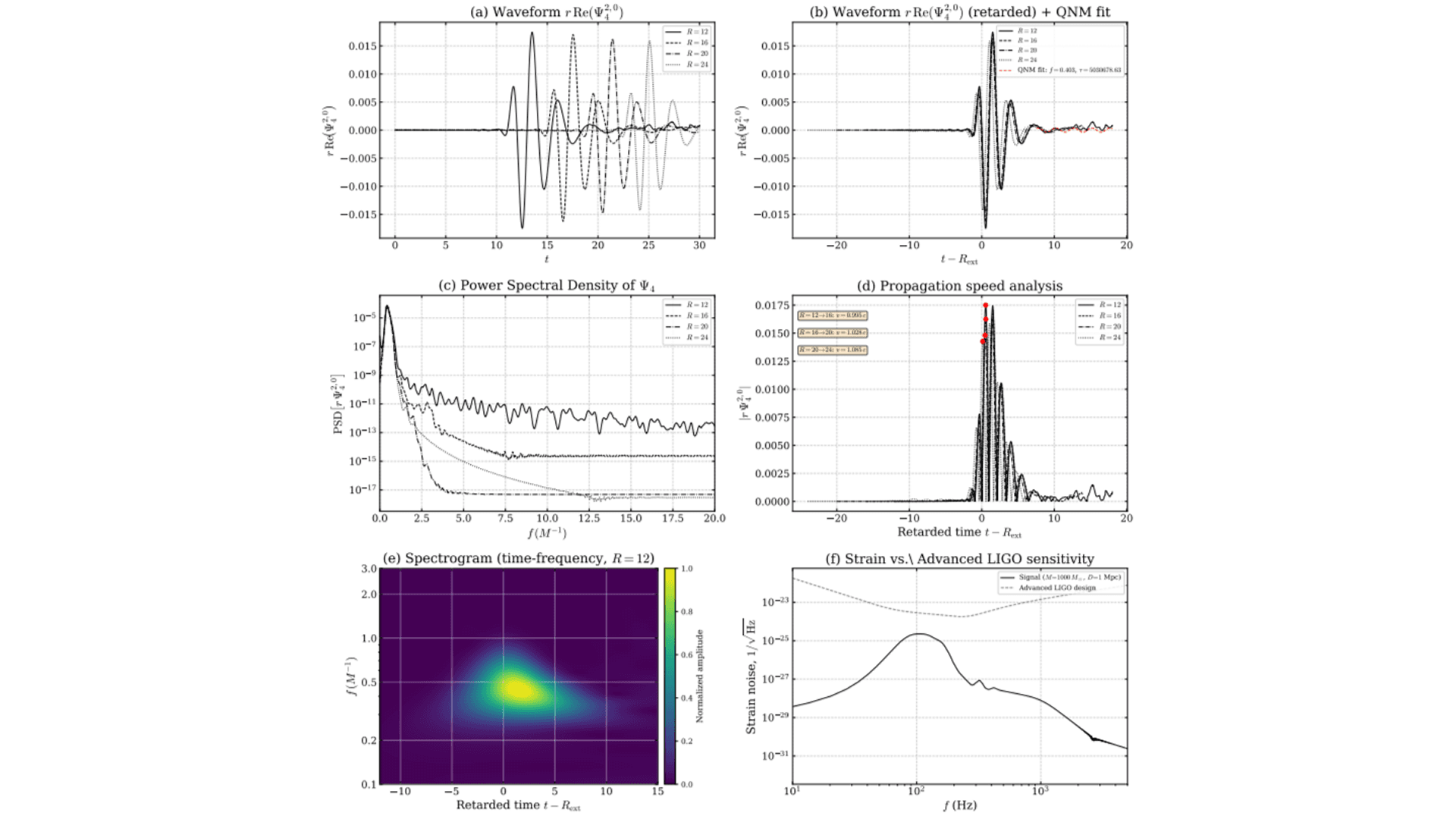
The work is important not only for theoretical gravity, but also for observational astronomy. For the collapse branch , reliable signatures of gravitational radiation, including the Weyl scalar (\Psi_4), were extracted for the first time.
At the same time, the signal from a collapsing wormhole is fundamentally different from the long "chirp" usual for black hole mergers. In this case, it is expected:
- short broadband low-frequency surge;
- then — ringing at an almost constant quasi-normal frequency.
This is an important difference: not only template methods are particularly promising for searching for such events, but also algorithms for searching for unmodeled bursts, since the waveform does not resemble the standard patterns of binary black holes.
Based on the results obtained, it was created and published Python is a toolkit that allows you to automatically download open LIGO/Virgo data via GWOSC and analyze it. Nevertheless , the work itself provides a more restrained assessment of the practical chances of detection than it should have been from the original text of the press release.

Detection is possible, but so far with limitations
For a simulated burrow with a mass of 1000 solar masses at a distance of 1 megaparsec, with a moderate disturbance, the signal amplitude is slightly below the Advanced LIGO sensitivity threshold. This means that with the current generation of ground-based detectors, confident detection would require either:
- significantly a closer object is on the order of up to 50 kiloparsecs,
- or significantly stronger initial asymmetry/deformation.
In other words, the work does not claim that such objects can be reliably captured "already today" at typical extragalactic distances, but it forms a realistic basis for a targeted search and shows exactly how such a search should be organized.
Not only LIGO and Virgo, but also the future LISA
The conclusion is especially important for supermassive objects. The paper emphasizes that if some objects in the centers of galaxies with masses of the order (10^6-10^8 M_\odot) are actually not black holes, but collapsing wormholes, then their gravitational wave signal should fall within the sensitivity range of the future LISA space observatory.
This expands the meaning of the study.: It concerns not only exotic compact objects of intermediate mass, but also the potential interpretation of the nature of the supermassive central objects of galaxies.

GPU as a breakthrough for numerical gravity
The solution of the equations of general relativity was implemented on a GPU architecture using the GRTeclyn framework. And here the work has a separate value: it showed not just the convenience of GPUs, but their fundamental advantage for tasks of this type.
For a full simulation, a bundle of eight H100 GPUs took about 24 hours, whereas a comparable calculation on a single high-performance CPU would take more than 44 days of continuous counting. Moreover, the cost of computing on the GPU turned out to be significantly lower — about 15-60% it depends on the price of the same time on traditional CPU supercomputers.
This is an important practical conclusion: the future of computational numerical gravity, especially in tasks limited by memory bandwidth, is largely related to graphics accelerators.
Scientific community support and open publication
An additional confirmation of the interest in the work was the official support (endorsement) from Professor K. A. Bronnikov, one of the creators of the wormhole model under study. This made it possible to successfully place the preprint on the arXiv.
At the moment:
- scientific an article with a full description of the results has been prepared and sent to Classical and Quantum Gravity;
- the original simulator code, visualization tools, and signal analysis tools published in an open repository under the BSD 3-Clause license.
What's next
The next step should be to simulate rotating wormholes. In the current work, gravitational radiation was initiated artificially by disrupting the balance of the phantom field and introducing a quadrupole deformation. The transition to rotating solutions will allow us to explore more natural astrophysical scenarios of wave generation.
An even more difficult task is to develop new calibration and numerical methods for describing the late stages of the phantom rebound and the inflationary regime. Without this, it is impossible to answer the key question: what exactly remains after the destruction of the event horizon and whether the inflating wormhole can ever reach a stable, potentially passable mode.
Result
Nikita Shirokov's project has yielded several fundamental results at once:
- for the first time a full-fledged 3D simulation of wormholes has been performed Ellis—Bronnikov;
- confirmed their fundamental instability;
- identified a dramatic collapse scenario with a "phantom bounce";
- shown, that the alternative branch leads to an inflationary expansion of the cosmic scale;
- received the first realistic predictions for LIGO/Virgo and the future LISA;
- demonstrated a clear advantage of GPU for numerical gravity tasks;
- published open source code that makes the results reproducible.
The work does not prove that wormholes will be found in the detector data tomorrow, and even more so does not confirm the possibility of immediate FTL flights. But it takes a much more important step: it moves the topic of wormholes from the realm of purely speculative constructions to the mode of specific numerical predictions, verifiable by observations and open source.