
The traffic police defended the work on black hole mergers and awarded the best student diplomas.
Ilya Chekhov's final thesis on mergers of primary black holes of intermediate masses and their possible observation by future space gravitational-wave interferometers was defended at the P. K. Sternberg State Astronomical Institute. The event was held in an academic format: the author presented the main provisions of the study, the results of numerical modeling and conclusions, after which he answered the questions of the commission and those present.
The topic of Ilya Chekhov's work is "Binary primary black holes of intermediate masses as sources for cosmic gravitational-wave interferometers." In the study, a predictive model of mergers of binary primordial black holes was built, potentially available for registration by the TianQin space interferometer. The work combined analytical estimates of merger rates, Monte Carlo modeling of individual binary systems, accounting for accretion mass growth, orbital evolution, and calculation of the signal-to-noise ratio.
One of the key results of the work is that accretion can significantly change the predicted observability of such objects. In numerical models, the inclusion of accretion increased the proportion of merged systems and led to the formation of a more massive "tail" of the population, which is especially important for detecting TianQin. According to calculations, under an optimistic Bondi–Hoyle accretion scenario, the number of potentially observed events can increase from a few to dozens or even hundreds of events per year. At the same time, the model was tested for consistency with the limitations of the LIGO/Virgo/KAGRA ground-based detectors and does not contradict modern observational data.
A separate part of the work was the developed software package for modeling populations of binary primary black holes. It allows you to change the parameters of the mass function, the proportion of primary black holes in dark matter, accretion models, initial orbital distributions, and detector characteristics.
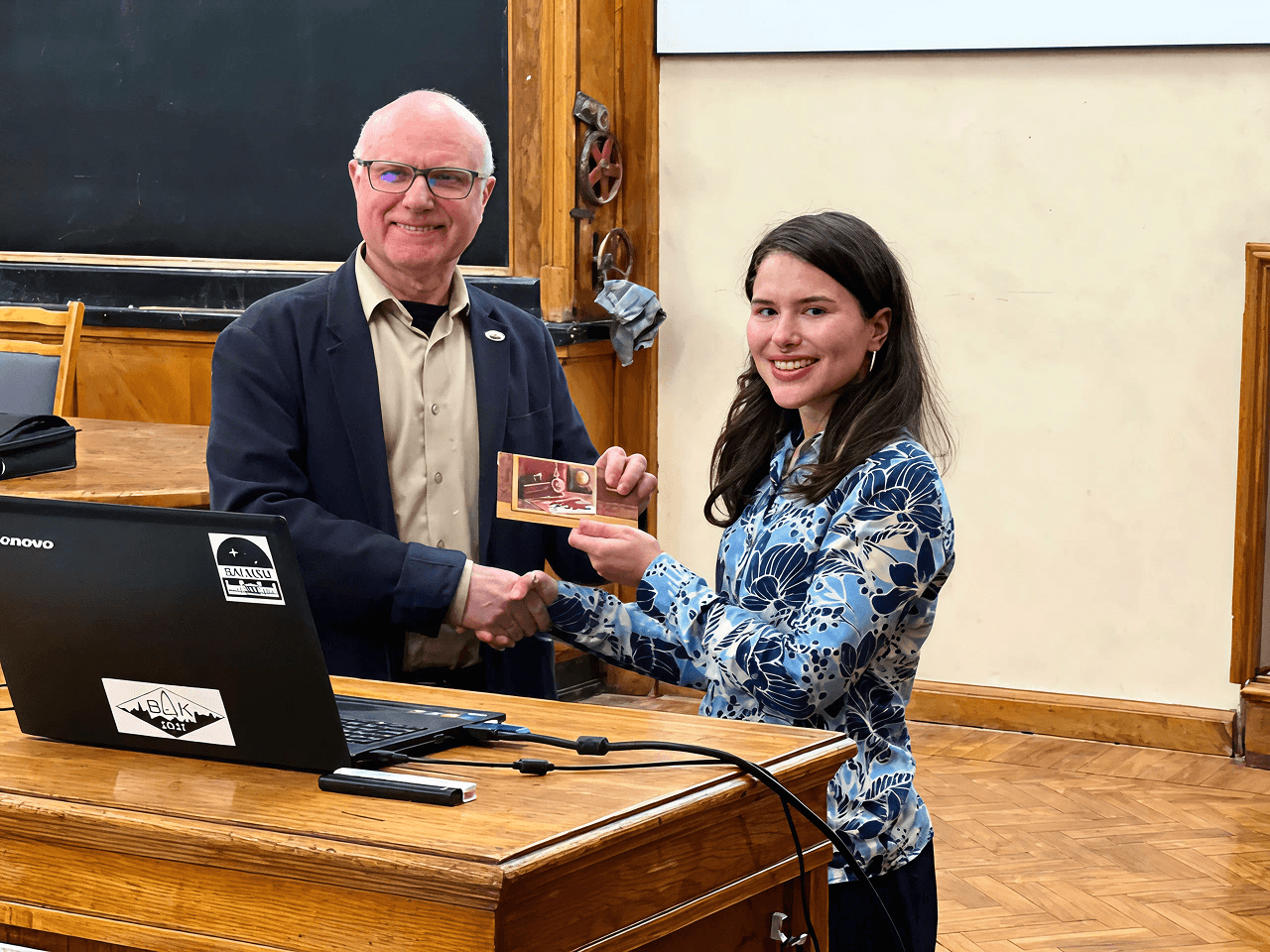
After the defense, the authors of the three best theses of traffic police students were awarded. Prizes in the amount of 20 thousand rubles were awarded to each laureate from the Frontiers of Science Guild.
Winners of the Frontiers of Science Guild Award
Yael Kosareva was awarded for her work "Panoramic spectroscopy of galaxies in close groups". The study is devoted to the study of gas accretion into galaxies in compact groups — dense systems where interactions between galaxies can significantly affect their evolution. The galaxies NGC 835, NGC 833, and NGC 128 were considered. Using panoramic spectroscopy, regions of ionized gas were identified, the mechanisms of its excitation were determined, fluxes in emission lines were measured, and metallicity was estimated. These results allow us to better understand the nature of intergalactic gas flows and the role of accretion in the evolution of galaxies.
Yuri Moiseev received an award for his work "Search for passable wormholes: theory and observations". It investigated the theoretical properties of traversable wormholes supported by phantom dark energy, as well as possible ways of their observational detection. The author considered the relationship between the parameters of wormholes and the characteristics of dark energy, estimated the probability of their formation, and proposed a search method based on the gravitational influence on the motion of stars. Modeling has shown that with sufficient accuracy and duration of observations, such effects can be detected in principle.
Artemy Vakhonin was awarded for his work "Studying the circumstellar dust shells of carbon stars using machine learning methods." The author has developed a neural network surrogate model for fast modeling of spectral energy distributions of carbon stars with dust shells. The model was trained on synthetic spectra calculated using RADMC-3D and tested on real objects. Thanks to integration with Bayesian analysis methods, it was possible to significantly speed up modeling: tasks that would have been practically unattainable with a direct calculation of radiation transfer can now be performed in hours. The work also showed signs of a predominance of fine dust in the shells of the carbon stars studied, although an expansion of the sample is required for statistically reliable conclusions.
The defense and subsequent awarding became an important event for the student scientific community of the Traffic police. The presented papers cover a wide range of topics in modern astrophysics, from gravitational waves and primordial black holes to the evolution of galaxies, exotic compact objects, and the use of machine learning in modeling stellar shells.