
Russian astronomers have discovered a new star in the Milky Way
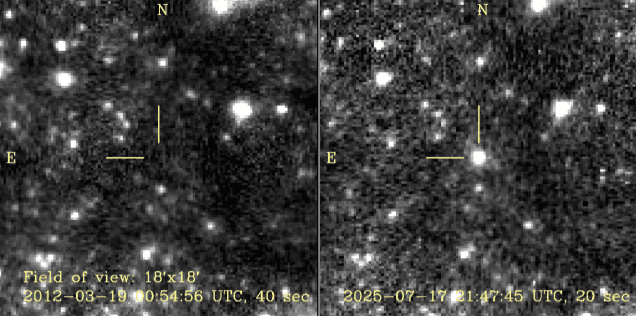
On July 18, at 00:48 Moscow time, a Russian team of astronomers obtained three images using a Canon 135mm f/2.0 lens and an ST-8300 CCD camera. The shooting took place as part of the New Milky Way survey of the Milky Way. Every clear night , the project takes pictures of the entire accessible Milky Way from the latitude of Arkhyz. Now this is the space from the constellation of Scorpio to the constellation of the Charioteer.

The penetration in the three images obtained is +14 magnitude; the last time this area of the sky was photographed as part of our survey was on the night of July 15th to 16th, that is, 48 hours before the discovery — then this object was not visible in the images.
Usually The new star consists of a pair: It's a white dwarf and a red dwarf. White attracts matter, mainly hydrogen, from red. When a critical density is reached, a thermonuclear explosion occurs on the surface of the white dwarf: it can increase The brightness of this star pair is one million times, that is, by 15 magnitudes. The brightness increases rapidly, by several magnitudes per day. At the peak The gloss lasts for a day, after which a gradual decrease in brightness begins. New stars are observed for 2-3 weeks. It happens that their visibility continues for years.
In the archive images (deep reviews), there were no stars visible in this place before. brighter than +22 zvl.vel.. There is a lot of cosmic dust there, which hides faint stars and can turn the flash light red. Other reviews (ASAS-SN – All-Sky Automated Survey for Supernovae, an automated study of the entire sky for supernovae; ZTF – Zwicky Transient Facility, a project monitoring the entire northern visible sky) confirmed that the star was flaring up. The day before the discovery, it was 11 times dimmer (+14.6 magnitude), that is, it became brighter very fast. 2 hours after opening, repeated snapshots showed that The brightness hasn't changed much yet.
Discovery The Astroverts team proves that even in an era of technological development, powerful instruments, and large observatories, we can constantly learn something new about the universe. We are pleased to support the project — fundamental science and space exploration are the main reason for the creation of the Guild. In addition, the team is engaged in science tourism, allowing For everyone who wants to look at the stars and be inspired by science , Astroverts support the popularity of the space industry," said Ilya Cech, co—founder of the Frontiers of Science Guild.
Total In Russia, seven New stars in the Milky Way have been discovered in 35 years. Of these, six were carried out by the Astrofarm team over 13 years of work; three of them were carried out over the past year. The full list of Astrofarm discoveries is available at this link.
Among the discoveries of the Astropharm are flashes of galactic New stars.:
- New Sagittarius 2012,
- New Cassiopeia 2020,
- New Persea 2020,
- New Chanterelles 2024,
- New Sagittarius 2025 No. 3
- New Snakes of 2025 No. 1.