
New Reality: Where does the game end and science begin?
Scientific characters
Perhaps the most famous "educated" video game hero is the laconic Gordon Freeman from Half Life. He holds a Ph.D. in theoretical physics from the Massachusetts Institute of Technology, and at the same time skillfully wields a branded crowbar and gravity cannon. His assistant in Half Life 2, the daughter of a scientist, is also smart and quick-witted.
The non—player character Alix was so loved by both critics and players that he eventually got his own game - she is the main character. The VR project Half-Life: Alyx, released in 2020.
Those who haven't read much of the materials or watched the screensavers in Prototype, but only jumped and flew around the city, mercilessly destroying everything that moves (and what doesn't move, he moved and destroyed), hardly remember that the main character is the result of the fusion of the Black Light virus and the corpse of a scientist, a doctor Alex Mercer.
Mercer worked at Gentek on biological weapons on behalf of the US government and the US Army and was the main researcher of the project to create the Black Light virus.
The main character of the Saturn game released in 2024 was the Russian scientist Akim Kovalev. Using technology called "Reflection," he controls anthropomorphic robots on Saturn's moons.
On the wall in the main character's house there is a diploma of participation in the National Technological Olympiad of the NTI, these are currently existing competitions for schoolchildren, where they solve problems in various fields — from artificial intelligence and "smart" energy to neurotechnology and genomic editing.
The mention of the Olympics in the game space highlights the character's connection with the real scientific environment and shows where his research thinking is formed from.
The game also features the "Reflection" technology, with which the hero controls robots on Saturn's moons — it fits into current areas of scientific and technological progress, including telepresence, cybernetics and human-machine interfaces.
The list of unplayable scientist characters, while negative, is much longer.:
- Dr. William Birkin created the T-virus that led to the zombie apocalypse in Resident Evil;
- Dr. Samuel Hayden coordinated the invasion of demons on Mars in DOOM;
- Dr. Eggman wants to conquer the world and is forever chasing the blue hedgehog Sonic;
- Dr. Wallace Breen is one of the main antagonists in Half-Life 2;
- Dr. Neo Cortex created Crash Bandicoot and was forced to fight him in an attempt to take over the world;
- Dr. Jonathan Crane is the Scarecrow in Batman.
...thousands of them.
Thus, for some reason, most of the scientists in video games are supervillains. Is this a conspiracy against the mind? Is the easiest way to create a negative character and explain its vast possibilities? Or, on the contrary, is it too difficult to create an interesting and "intelligent", educated character who would be the main character of the game?
The Saturn developers said that the decision to make the scientist the main character became part of the overall approach:
We tried to show a positive, active image of a scientist, as opposed to the archetype of a villainous scientist common in pop culture. When creating the character, we were inspired by the works of Alexander Belyaev, Stanislav Lem and the Strugatsky brothers, where scientific thought is presented as a path to development and the search for truth, not destruction.
Science Games
Of course, the easiest way here is to list video games related to education. There are many projects that help train surgeons, engineers, historians, and other specialists. Often we are talking about simulators of any processes - engine assembly, operations, painting wagons, welding seams. But these are too highly specialized tasks, and in this article we are interested in spreading scientific knowledge to a wide audience.
Among the games that come to mind in this case will, of course, be Plague Inc.— a simulator of the spread of the disease. It is based on a complex and realistic model of the spread of the epidemic.
This is IGN's "Best Strategy Game of 2012" , which has not lost its relevance. Moreover, there was a surge of interest amid the outbreak of coronavirus in China — the game became the fastest -selling entertainment project on the Chinese App Store.
You can at least partially understand how evolution works by using such an interesting toy as Spore. The game belongs to the genre of " god simulator" and gives you the opportunity to conduct your own kind of living beings from a single-celled microorganism to a civilization capable of plowing the vastness of the universe on spaceships.
Although from the point of view of the scientists gathered by the journal Science, the game perfectly shows the structure of the galaxy and society, but the process of evolution is distorted — there are too many assumptions. On the other hand, if a game arouses at least someone's desire to explore a scientific topic more deeply, this is already a useful project.
And what are the scientists themselves playing at? Such a question was asked Leonid Ledentsov, Ph.D., Senior Researcher at the Department of Solar Physics P. K. Sternberg State Astronomical Institute, Lomonosov Moscow State University.
In my youth, I played Worms with other students and Quake, Civilization and "Gothic" were also interesting at that age. In childhood — Need For Speed and Driver. Now I personally have less interest in games, but my wife and I have tried modern games for two; unfortunately, Resident Evil 6, It Takes Two, and Portal 2 are nothing compared to what we 've played before. But the scientific youth still prefers classics like Heroes., Counter Strike and Civilization, as well as projects with free worlds like RPGs and space simulators.
Leonid Ledentsov, Ph.D., Senior Researcher at the Department of Solar Physics , P. K. Sternberg State Astronomical Institute, Lomonosov Moscow State University
Citizen Science: Games as Crowdsourcing for scientists
Together with the Gutenberg Smoking Room, we are giving a new impetus to "Citizen Science." Within the Guild, we are creating the OnlyGames platform, a key tool for promoting scientific knowledge. This platform, convenient for gamers, developers, writers and streamers, will open access to an audience ready to learn and create new things. The bet is justified: Russia's gaming audience is huge," said Ilya Cech, co—founder of the Frontiers of Science Guild.
According to the head of Roscosmos, Dmitry Bakanov, The Guild will become one of the three main initiatives around which space startups in Russia will focus.
What exactly is "Citizen Science"? In 1995, Alan Irving outlined the concept of citizen science, or scientific volunteerism, in the book "Citizen Science: A Study of People, Experiences, and Sustainable Development." Long before the advent of this concept, the technique itself was used in the USSR. "Folk" science was closely intertwined with professional science due to the openness of the Institute of science itself, it played an important role in the development of society.
Now the topic is relevant again – in the plan for the "Decade of Science and Technology" in Russia, which was approved by Mikhail Mishustin in 2022, it was noted that it was necessary to involve more than 100,000 volunteers in the implementation of scientific projects by 2025.
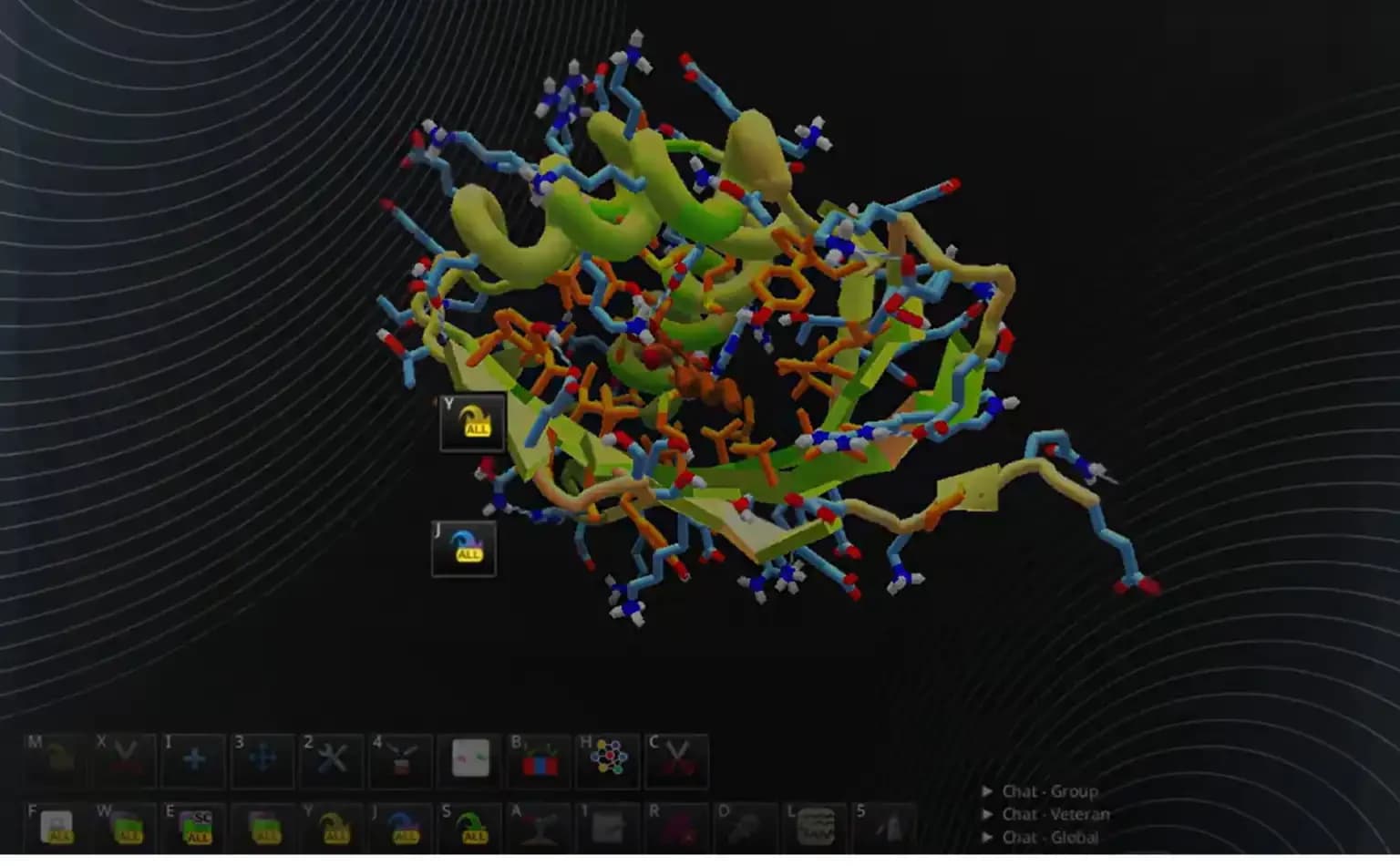
Games are one of the ways to attract a wide audience to scientific projects. For example, gamers with no knowledge of chemistry can play the Foldit online puzzle game, where they change the amino acid sequence; the result of the project was the decoding of the virus that causes AIDS in monkeys, and a change in the structure of the protein responsible for catalyzing the Diels—Alder reaction. And developer David Baker won the Nobel Prize in Chemistry for "Designing new types of proteins."
One of the similar projects is EteRNA from the University Carnegie Mellon and Stanford University, Phylo from McGill University, Stall Catchers from the Institute of Human Computing.
EVE Online developers, CCP Games Studio, released a mini-game "Project Discovery" – in it, players identify localization of proteins in human cells for a reward, which can then be used in EVE Online. The mini-game was released in partnership with "Human Protein Atlas" and the citizen science platform Massively Multiplayer Online Science. As a result, the players, for example, helped scientists monitor the body's "immune response" to the coronavirus.
The Borderlands game has a built-in Borderlands Science puzzle. Users try to line up the tiles exactly, and the collected data is eventually used to create accurate models of the human microbiome. From 2020 to 2024, 700,000 players solved more than 36 million puzzles.
Video games as a science
Actually, video game development can be considered as a science. Initially, a video game is a complex software product that is often at the absolute forefront of technology development, whether it's 3D simulation and physics, Motion Capture based on character facial expressions, neural networks for NPCs and UX analysis in game design, complex distributed systems for creating multiplayer games.
This topic is planned to be discussed on August 9-10 at the House of Scientists in Pushchino (Moscow region) at the conference "ICAC? Games as science 2025". The event will be attended by developers and gamers, as well as scientists, as well as technology entrepreneurs. For example, Ilya Cech joined the Commission to evaluate games from the point of view of science — we are talking about innovations in games, popular science and educational projects, as well as those games that are suitable for laboratory research.
Interestingly, the festival is part of the "Decade of Science and Technology in Russia" and solves the task of creating a "bridge" between video game developers and scientists. The event is also designed to dispel various myths around the creation of games. Open lectures, master classes, and game showcases can be attended not only by specialists, but also by everyone who wants to - admission is free after registration. Computerra is the media partner of the event.