
Space conveyor and nuclear reactors for the Moon: how private business is changing Russian cosmonautics at INNOPROM
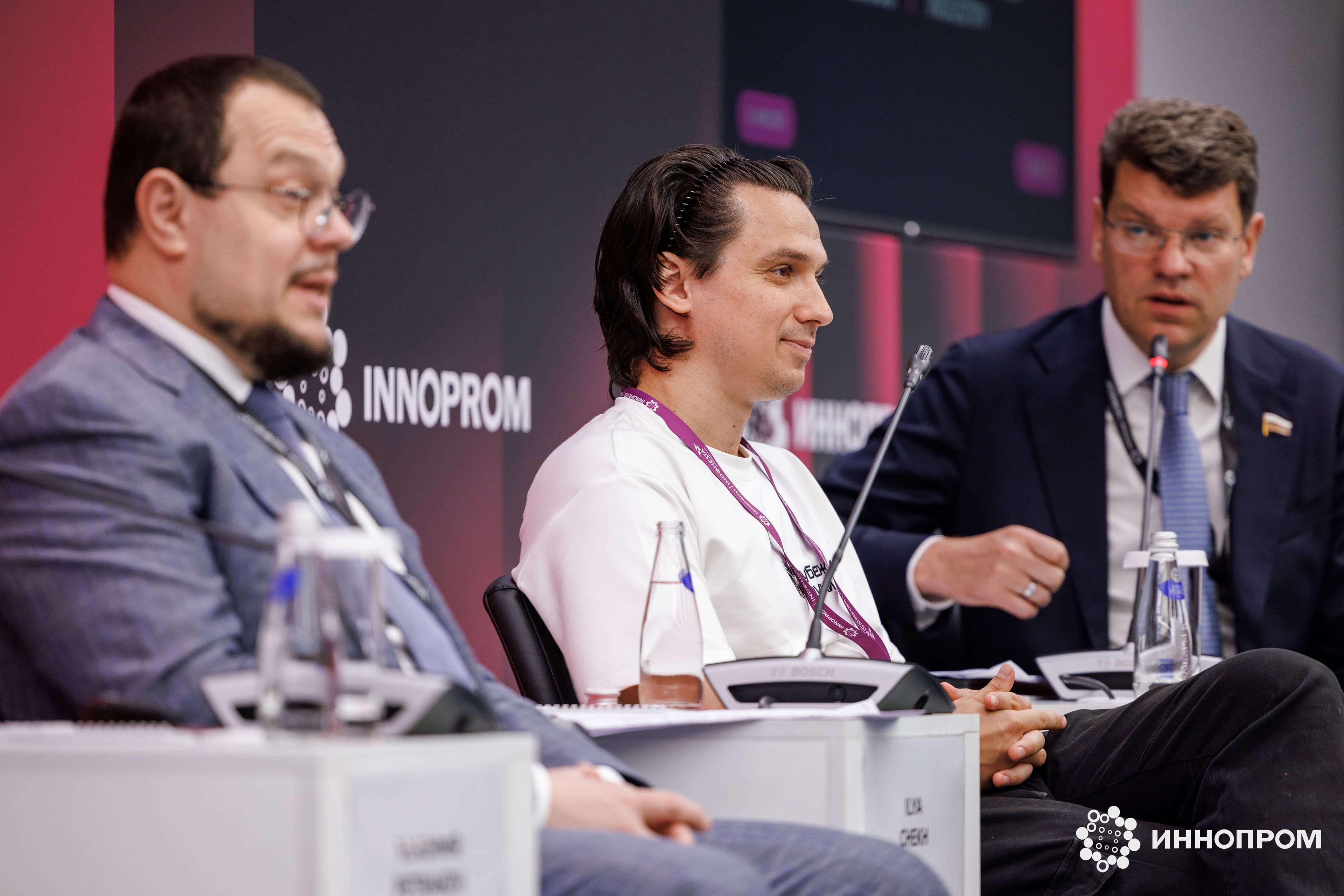
For a long time, the space industry in our country has been associated exclusively with large-scale government programs. However, the recent INNOPROM exhibition has clearly shown that the rules of the game are changing. Serious discussions about the transition to satellite assembly-line production took place on the sidelines of the forum, and private business not only announced itself, but also presented projects comparable in ambition to the plans of the world's leading space agencies.
Ilya Cech, CEO of the Frontiers of Science Guild, became the main newsmaker of the space track. His statements caused a noticeable response in the federal and specialized media. The Czech spoke about the development of small nuclear reactors with a capacity of up to 170 MW, which in the future will be able to provide energy for both Arctic facilities and future lunar stations.
In addition, Frontiers of Science is working on the creation of a bioreactor for life support systems in space and a unique laser complex designed to study gravitational waves. These announcements were the best illustration of the fact that the planning horizon of Russian private startups today goes far beyond the assembly of simple microsatellites.
From the piece assembly to the space conveyor
But in order for grandiose plans to become reality, the industry needs to radically restructure its production processes. This was discussed in detail on July 6 at the session "Made for space. Space conveyor: mass production of rockets and satellites as a new industrial challenge."
Under the moderation of State Duma Deputy Denis Kravchenko, experts discussed an ambitious task — a multiple increase in the Russian orbital group. In numbers, this means the launch of more than 500 satellites and 50 launch vehicles annually.
The participants agreed that it is impossible to achieve such indicators in the old-fashioned way. The industry needs production lines of assembly, strict unification and modularity of platforms. The personnel problem also remains acute — Mikhail Gordin, rector of the Bauman Moscow State Technical University, noted that engineers of a completely new formation are required for high-tech serial production. Ilya Cech, who also spoke at this session, stressed that it would simply not be possible to solve the problem of mass production of spacecraft without the active involvement of flexible and fast private companies.

Private space exploration: no longer a myth
The next day, on July 7, the theme was developed at the Moscow Government stand. The session, moderated by TV presenter Sergey Malozyomov, was called "Private Cosmonautics: Myth or reality."
Vladimir Petrakov, a representative of the capital's Department of Investment and Industrial Policy, told how the city helps startups in their early stages by providing subsidies and infrastructure. The position of Roscosmos turned out to be interesting. Grigory Maksimov, Deputy General Director of the state corporation, made it clear that the agency sees private companies not as competitors, but as full-fledged partners stimulating the development of the industry as a whole.
The fact that private space is already a tangible reality has been confirmed by representatives of the business itself. Anatoly Kopik from SPUTNIX, Andrey Ionin (Geoscan) and Georgy Emelin (Space Energy) spoke about practical experience in creating small spacecraft, remote sensing systems and work on ultralight rockets. In turn, Alexey Rogatnev from Nex-T Group of Companies raised an important issue of the production of components and electronics, for which government customers and private businesses often have very different requests.

Speeddating for industry
The talks about the need for a rapprochement between the state and business at INNOPROM were reinforced by deeds. One of the most interesting formats of the event was industrial B2B scouting, the so-called speed dating for suppliers and purchasers.
The format worked extremely pragmatically: representatives of 10 large customer companies were accommodated in the hall, to which potential suppliers joined according to a pre-approved schedule. It took exactly 15 minutes to present their technologies and interest a partner.
It is significant that at one of the tables the reception of suppliers was conducted jointly by representatives of the state corporation Roscosmos and the private company Guild Frontiers of Science. The very fact that the public sector and a private startup are looking shoulder to shoulder for technological solutions in the market speaks volumes. By the way, the level of purchasers at speeddating was the highest — along with space players, representatives of VSMPO-AVISMA, SIBUR, ODK, Rosatom, Transmashholding, BelAZ and the Kalashnikov concern were looking for new solutions.
The results of INNOPROM's space program are obvious: the Russian rocket and space industry is becoming more open. The emphasis is on serial production, a pragmatic search for suppliers and, most importantly, on the courage of private entrepreneurs who are ready to take a swing at projects on a global scale.