
Ilya Cech spoke at the closed-door discussion "Cosmos 2.0: technologies that will change our lives in 5 years"
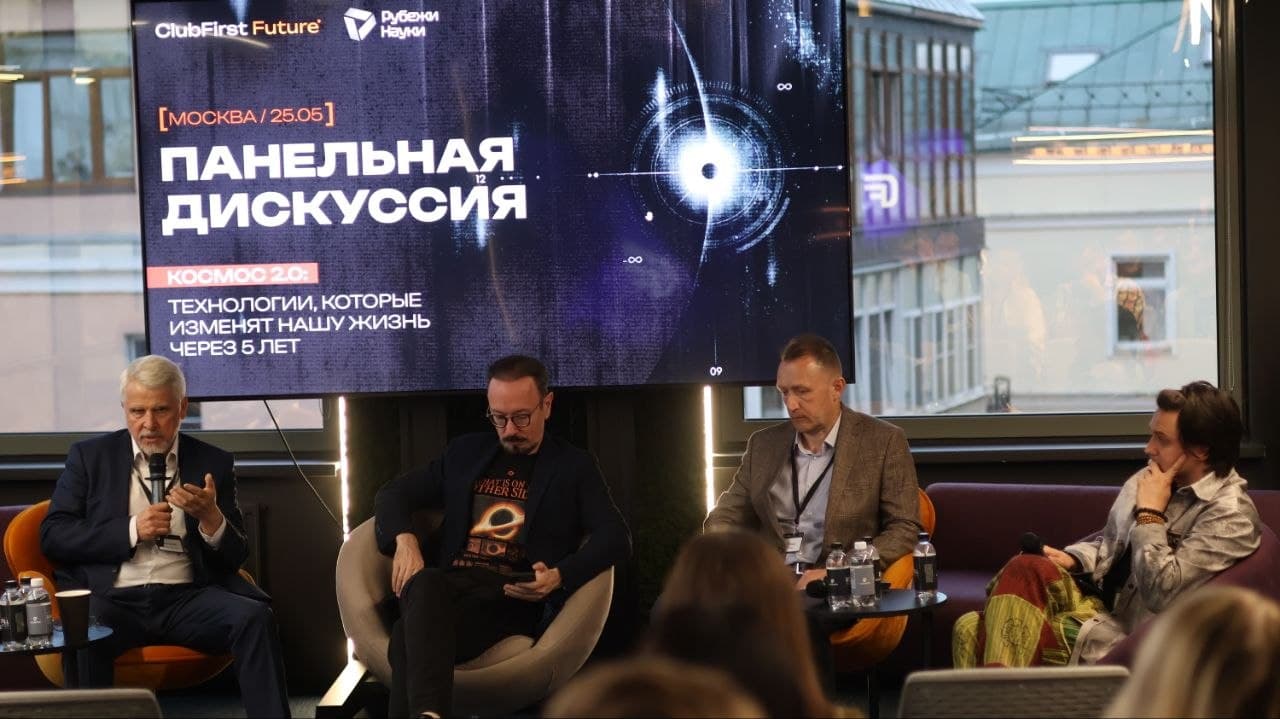
On May 25 , the Frontiers of Science Guild, together with ClubFirst, held a closed expert discussion "Space 2.0: technologies that will change our lives in 5 years." The event brought together representatives of the space industry, technology entrepreneurs, investors, and experts interested in developing new markets at the intersection of science, business, and high technology.
Ilya Cech, head of the Frontiers of Science Guild and founder of the Motorika company, became one of the speakers of the discussion. In his speech, he spoke about new markets, entrepreneurial opportunities and growth points that remain undervalued today, but may become the basis for major technology projects in the coming years.
Space as a new economic infrastructure
The main conclusion of the discussion was the understanding that space is no longer solely the domain of scientific experiments and government programs. It is becoming the new infrastructure of the global economy.
Previously , space was perceived as an area of complex research accessible to a limited number of specialists, but today it is increasingly becoming an industry. In the next 5-10 years, this transition will become particularly noticeable: from "space as an experiment" to "space as an industry", where real markets, business models and investment opportunities are being formed.
The participants of the meeting noted that space technologies are already affecting everyday life much more than is commonly thought. Satellites provide navigation, communications, Internet, weather services, logistics, territory monitoring, and many other systems. According to experts, the disappearance of satellite infrastructure could lead to serious losses for developed economies, up to a significant share of GDP.
What was discussed at the discussion
The purpose of the event was to show the direct connection of space technologies with the economy, new markets and real business. The discussion turned out to be not only futuristic, but also applied: the participants discussed not an abstract "distant future", but specific areas that could change people's lives in the coming years.
Among the key topics of the meeting were:
- commercial space exploration;
- development of satellite services;
- space communication and navigation;
- robotics and autonomous systems;
- the orbital infrastructure;
- production of materials in space;
- the prospects of the Moon and asteroids as an industrial bases;
- the role of artificial intelligence in management space systems;
- personnel shortage in high-tech industries;
- new opportunities for entrepreneurs and investors.
Special attention Attention was paid to the fact that space is becoming a business space. The future of the industry will increasingly depend not only on large government programs, but also on entrepreneurs, startups, young private companies, and technology teams capable of quickly creating products and bringing them to market.
Speakers of the event
The tone of the discussion was set by leading experts and representatives of the technology business:
Evgeniy Kuznetsov, CEO of Digital Evolution Ventures, Rosatom State Corporation, spoke about technological trends, venture capital opportunities and new investment directions in the space sector.
Nikolay Nikolayevich Sevastyanov, General Designer of Space Systems, Honored Designer of the Russian Federation, spoke about satellite communications, the exploration of the Moon, helium-3 and the transition of ideas that until recently seemed fantastic to the real economy.
Roman Zhits, CEO of Voskhod – Space Technologies, shared his view on investor demands and the commercial potential of orbital solutions.
Ilya Cech, Head The founder of the Frontiers of Science Guild and the founder of the Motorika company spoke about new markets and opportunities that open up for entrepreneurs in the context of the rapid development of space technologies.
Ilya Cech's speech: space needs entrepreneurs
In his speech, Ilya Cech stressed that space today is not only about rockets, orbits and complex engineering. This is a new environment for creating products, services, and technology companies.
According to him, entrepreneurs should look at the space industry as a space of opportunity. Areas where private companies can create in-demand solutions are already being formed: from satellite services and data analysis to robotics, batteries, new materials and communication systems.
A special emphasis was placed on the fact that many promising niches still remain undervalued by the market. It is in such areas that companies often appear, which in a few years become leaders of a new industry. Entrepreneurs who are able to enter these segments now can gain a significant advantage in the next 3-5 years.
From SpaceX to orbital data centers
The panelists also discussed international experience in the development of private space exploration. One of the most striking examples was SpaceX, which has changed the perception of the industry in many ways. Its success lies in the fact that space has begun to transform from an elite and ultra-expensive sphere into a more massive and mass-produced product.
Rockets, satellites, launches, and related infrastructure are gradually becoming part of the industrial and commercial cycle. This creates fundamentally new business conditions and reduces entry barriers for private players.
Among the futuristic, but already discussed scenarios were:
- creature orbital data centers as the new digital infrastructure of the Earth;
- bioprinting of organs and tissues in space for development earth medicine;
- production of unique materials in conditions of microgravity;
- development of autonomous orbital platforms;
- possible genetic adaptation of humans for long-range space flights.
The main results of the discussion
Following the meeting, the participants agreed that space had finally ceased to be a "distant story." It is already affecting the economy, and in the coming years this influence will only increase.
Among the key conclusions of the discussion:
Space
is becoming an industry.
Applications, commercial products, and business models come to the fore. Satellite services,
data analysis, autonomous systems, and new materials are shaping the markets of the future.
The main
constraint is not technology, but personnel.
The industry lacks engineers and
specialists capable of working at the intersection of space, AI, robotics,
materials science and business. The personnel training system needs to change faster.
Data is one
of the most valuable assets.
Satellite imagery, remote
sensing, predictive analytics, and processing of large amounts of information
can form the basis for new billion-dollar markets.
AI and
robotics enhance humans.
Algorithms will play an increasingly
important role in managing satellites, stations, and autonomous systems, but
strategic decisions, especially in non-standard situations, will remain
with humans.
The moon and
asteroids are already a planning horizon.
Resource extraction, production
of materials in space, and the construction of orbital infrastructure require
a long-term approach, consortia, and public-private partnerships, but
the first technological steps can be taken in the coming years.
The new role of business in space
One of the central thoughts of the event was that the cosmos needs entrepreneurs. It is business that is able to accelerate the implementation of technologies, search for effective models, create products and find practical applications for scientific developments.
The participants named the following promising areas for companies and startups:
- satellite services;
- navigation solutions;
- space communication;
- robotics;
- battery technology;
- new materials;
- satellite data analysis;
- autonomous systems;
- infrastructure solutions for orbit.
The discussion showed that entrepreneurs are no longer asking the question "why do we need space?". Increasingly, they are asking: "how quickly can we enter this market?" and "where is the economy here?".
What's next
Guild "Frontiers Sciences" will continue a series of private meetings dedicated to space, new technologies and entrepreneurship. Such events become a platform where experts, investors and entrepreneurs can discuss not only technological trends, but also real scenarios for the development of future industries.
The closed discussion "Space 2.0: technologies that will change our lives in 5 years" showed that space is no longer just about rockets and long—range flights. It's about economics, data, infrastructure, medicine, communications, materials, and new markets.
And most importantly, it 's about the future that is being created today.