
Man was able to breathe with the help of microalgae: a step towards an autonomous life support system for the Moon and Mars
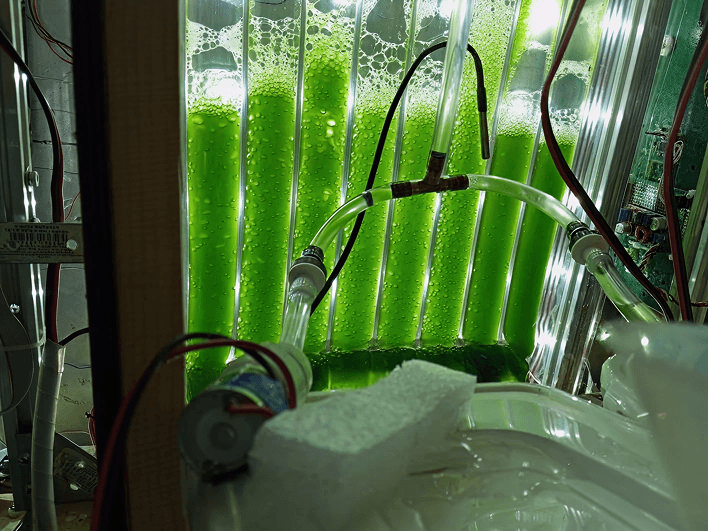
The 435nm project is being implemented by a team of engineers led by Alexander Shayenko. The investor is the Frontiers of Science Guild, and the scientific base is based on the developments of the Institute of Biomedical Problems of the Russian Academy of Sciences - IMBP RAS.
The main result of the project has already been achieved: a person was able to breathe with the help of microalgae. After almost ten years of experimentation, the installation reached a stable gas exchange mode, and Alexander Shayenko spent 45 minutes wearing a mask connected to the system. According to him, he could continue the experiment further.
This event was an important step towards creating an autonomous life support system that can be used in space in the future — during long-term flights, on lunar and Martian bases.
In the near future, the project team will hold a public demonstration of the installation, where you can find out the details of its device and try to breathe with its help.
What the team is developing
A team of engineers led by Alexander Shayenko is developing a photobioreactor, an installation in which microalgae are grown under controlled conditions. Microalgae, capable of absorbing carbon dioxide and releasing oxygen during photosynthesis, become the basis of the system.
Such technology can become a key element of future space missions, because microalgae are capable of performing several tasks at once:
to absorb carbon dioxide that a person exhales;
to produce oxygen for breathing;
participate in water purification;
accumulate biomass, which can be processed into food in the future;
become part of a closed life support system.
In other words, the photobioreactor should not just produce oxygen, but become an element of a small artificial biosphere where human waste is converted into resources.
The main result: a person breathed oxygen from microalgae
The most important achievement of the project is a successful experiment with human participation. Alexander Shayenko was wearing a mask connected to a microalgae system for 45 minutes.
According to him, the system has reached the established gas exchange mode. This means that the process was not a short-term burst: the installation worked stably, maintaining the parameters at which a person could breathe.
"An event has just happened in our project, for which it was conceived. I was able to breathe with the help of microalgae, and we can assume that according to the parameters of gas exchange, it has reached a steady state," said Alexander Shayenko.
He noted that the experiment could be continued:
"I sat with a mask on my face for 45 minutes and could have continued to sit. Almost ten years of work."
According to Alexander Shayenko, this is probably the first such result in the country since 1981:
"It is very likely that for the first time since 1981 in our country, a person breathed with the help of microalgae."
How did it feel to breathe through the system
During the experiment, the composition of the air was different from the usual one. The level of carbon dioxide was higher than in the atmosphere, but there was no serious discomfort.
Alexander Shayenko explained that the air did not feel perfectly fresh, but it was possible to breathe it. There was no shortness of breath, headache, loss of consciousness or other dangerous symptoms.
"It didn't feel much different. You're breathing, the air is not the freshest, but nevertheless, you can breathe," said Alexander Shayenko.
This result is especially important because it shows that microalgae can be not only an object of laboratory cultivation, but also a real working element of a system that supports human respiration.
Nevertheless, in the following experimental installations, the gas composition will gradually approach the usual one.
Why is it necessary in space
In low-Earth orbit, crews can be supplied from Earth: to deliver air, water, food and equipment. But for long-range missions, this approach becomes too complicated and expensive.
If people go to Mars or start building bases on the Moon, it will be impossible to constantly carry everything they need from Earth. Therefore, astronautics needs an autonomous system that can maximize life cycles.
Such a system should:
return oxygen to the respiratory circuit;
recycle carbon dioxide;
purify and reuse water;
recycle crew waste;
partially or completely produce food.
Alexander Shayenko emphasizes that at the current level of technology, the most realistic way to create food and a closed environment is to use living organisms.
"So far, at the current level of technology development, the only way to make food for humans is to use living organisms," he explains.
That is why microalgae are considered as a promising basis for a space life support system.
How the project appeared
The idea of the project arose after the completion of work on the Mayak satellite. The team wanted to continue working on space technology, but was looking for a direction that would not necessarily require an immediate launch into space.
In 2016, Alexander Shayenko met with colleagues from the Institute of Biomedical Problems of the Russian Academy of Sciences.
It was about the use of chlorella and other microalgae to create biotechnical life support systems in space. IMBP RAS already had scientific developments in this area, which the project team began to rely on.
The first installations appeared in 2017. They were simple, but already automated. This was followed by a series of new versions. According to Alexander Shayenko, the installation, which succeeded in conducting an experiment with human breathing, has become about the tenth iteration.
Who is involved in the project
The project is being implemented by a team of engineers led by Alexander Shayenko.
The investor is the Frontiers of Science Guild. It is she who supports the development of a system that in the future may become part of autonomous life support for space missions.
The scientific base of the project is based on the developments of the Institute of Biomedical Problems of the Russian Academy of Sciences. IMBP deals with issues of medicine, biology and human life support in extreme conditions, including space flights.
Thus, the project combines engineering, private investment and a scientific foundation created by experts in the field of space biology and medicine.
What are the risks?
Like any complex system, a photobioreactor can fail. It is especially important to take into account that we are talking about a living culture: microalgae depend on light, temperature, composition of the medium, gas supply and other parameters.
Alexander Shayenko notes that such systems need to be duplicated for real use. For example, you can use several reactors: one is running, the other is in reserve. A backup physico-chemical system is also possible, which will be able to release oxygen and purify water in the event of a failure of the biological part.
In other words, microalgae can become the main system in space, but there must be backup solutions next to it. Reliability is achieved not by a single installation, but by a well-thought-out life support architecture.
What's next
After a successful experiment, the team plans to analyze the data, summarize the results and eliminate technical shortcomings. However, the next key step is to find a specific application and customer.
For further development, it is necessary to understand the conditions under which the system is being created:
for one person, three, six or more crew;
for what duration of the mission;
with what restrictions on weight and volume;
with what available energy consumption;
for a ground experiment, an orbital station, a lunar base, or a Martian expedition;
which functions should be prioritized — oxygen, water, food, or a full cycle.
According to Alexander Shayenko, it is difficult to determine the exact technical requirements without a specific customer. Therefore, further work will be related to finding practical applications and preparing the system for more extensive testing.
Long-term ground experiments are needed before sending such technologies into space. First, the system needs to be tested in a laboratory, then in conditions close to real ones, and only after that can we talk about using it in space missions.
Why is this important
The experiment in which a person breathed for 45 minutes with the help of microalgae is not just a demonstration. This is proof that a biological system can become a real part of life support technology.
So far, this is the first step. The photobioreactor will have to become more reliable, compact and safe. In the future, he should not only support breathing, but also participate in water purification and food production.
But the main thing has already happened: a person was able to breathe thanks to microalgae. This means that the idea of an autonomous biosphere for space is becoming not a fantasy, but an engineering task.
If such technologies are developed, future bases on the Moon and Mars will be less dependent on supplies from Earth. This means that a person will have more chances to live and work outside their home planet.