
Automatic metric search for interstellar flights
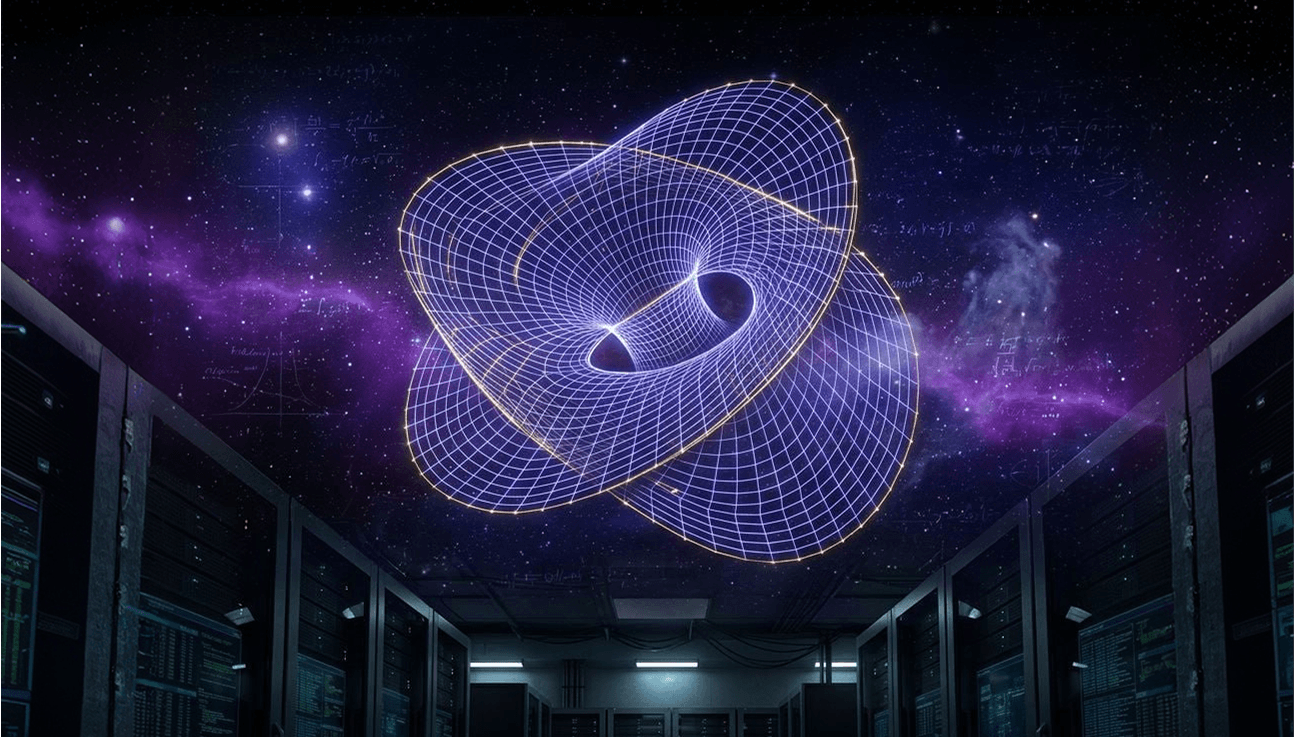
Nikita Shirokov, with the support of the Frontiers of Science Guild, is launching a project to automatically search for new space-time metrics that can potentially be applied to interstellar flight tasks. We are not talking about repeating already well-known ideas like the Alcubierre warp bubble or the Ellis-Bronnikov wormholes, but about finding fundamentally new geometries that a person could never manually deduce.
In general relativity, a metric describes the shape of space and time.: how distances are measured, how time flows, and how the curvature of space is related to matter. If you choose a special metric configuration, theoretically structures can appear that shorten the path between remote areas or create the effect of FTL travel. However, the known solutions face two key problems: they require exotic matter with negative energy and, as a rule, turn out to be dynamically unstable.
The goal of the project is to build an automated pipeline that will search for such configurations not manually, but using a computing agent. The agent suggests candidates for a new spacetime geometry, after which they are checked for compliance with Einstein's equations and modeled in time. If the configuration collapses quickly, leads to the formation of a black hole, or requires too much exotic matter, it is discarded. If it remains stable and shows useful properties, the algorithm uses this result for the next generation of search.
The technological basis of the project is the GRTeclyn numerical engine and a GPU cluster based on NVIDIA H100. GRTeclyn solves Einstein's equations in full three-dimensional form and supports modeling the interaction of geometry and matter. The GPU cluster allows you to perform such calculations quickly enough to move from single experiments to a massive search for thousands of candidates.
The key feature of the approach is the closed loop of numerical relativity. The search algorithm generates geometry parameters, GRTeclyn performs a 3D simulation, diagnostic scripts evaluate the result, and then the estimate is returned to the agent. In this way, the system gradually shifts the search towards more stable and physically feasible solutions.
Candidates are evaluated according to several criteria: the survival rate of the calculation, the fulfillment of Einstein's equations, dynamic stability, the absence of a black hole horizon, the minimal need for exotic matter and the difference from ordinary flat space. The parameters directly related to interstellar flights are checked separately: the presence of a real FTL effect and the safety of the central area for the simulated ship and crew.
The first GPU launches have already confirmed the pipeline's operability. The system generates candidates, passes them to the C++/GPU calculation, simulates the evolution and returns the estimate without manual intervention. Both spherical and non-spherical configurations, including dipole and quadrupole deformations, have been successfully calculated. At the same time, the first results also showed the main challenge of the next stage: some candidates formally undergo a short calculation, but then slowly begin to collapse. Therefore, special emphasis in the future search will be placed on long-term stability.
In the coming months, the project will focus on increasing simulation time, clarifying stability criteria, expanding verification of energy conditions, and a large-scale search for non-spherical geometries. For the best candidates, an attempt is planned to extract analytical formulas in order to obtain not just a numerical result, but a new accurate metric found by machine search and confirmed by repeated modeling.
The main expected result is a catalog of new space—time geometries that have been dynamically tested, and ideally, the detection of a stable configuration with signs of the superluminal effect and minimal need for exotic matter. If such solutions exist within the framework of general relativity, this project creates one of the most direct ways to find them.
In fact, it is an AlphaFold analog for space-time physics. AlphaFold has changed its approach to predicting the structure of proteins: instead of manually searching and long experimental selection, it uses computational methods to find the most likely spatial configurations of protein molecules. In this case, the logic is similar, but the object of the search is different: instead of sorting through the structures of the protein, the structure of space-time is sorted through — possible metrics and geometries of the universe. And the role of experimental verification is performed not by laboratory analysis, but by GPU simulation of Einstein's equations, which shows whether the found configuration can exist in time without collapsing and turning into a black hole.