
Astronomical Italy: a journey through the history of science with "Astroverts"
The journey "Astronomical Italy" will take place from July 24 to August 7, 2026 and will be devoted to the history of astronomy — from the first Galileo telescopes to modern methods of studying the universe.
This is a route for those who want to see Italy not only as a country of art, architecture and ancient cities, but also as one of the most important places in the history of science.
From Galileo to modern observatories
The main theme of the tour is the development of astronomy and natural sciences. Participants will visit places related to life and work Galileo Galilei, will see the houses where he lived, and will visit the museum, which contains scientific instruments from the Middle Ages to the beginning of the XX century.
The program includes the Galileo Museum, one of the oldest natural science museums. There are telescopes, microscopes, maps and globes of the starry sky, astrolabes, angle measuring instruments and instruments for scientific experiments. Among the exhibits are Galileo Galilei's first telescopes and a lens from his first telescope.
A separate part of the trip will be devoted to modern astrophysics. Participants will visit the gravitational wave detector VIRGO is an installation that allows you to register disturbances in space and time from the merger of black holes and neutron stars.
The program also includes a visit to one of the operating Italian observatories.
Scientific cities of Italy
The tour route will pass through several iconic locations Italy.
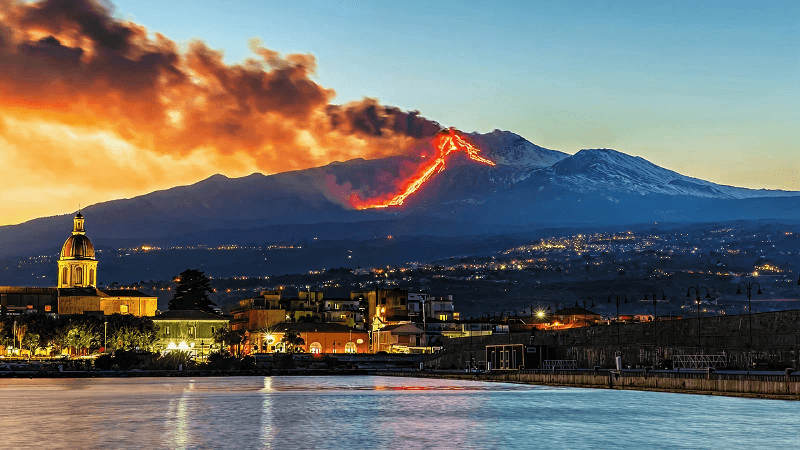
In Sicily, participants will climb Mount Etna , the most active volcano in Europe, if weather conditions and the seismic state of the volcano allow. The program also includes a vacation on the Mediterranean coast.
Then the trip will continue to Pisa. Here, participants will explore places associated with Galileo Galilei, Enrico Fermi and Bruno Pontecorvo is a scientist associated with the development of neutrino physics. A visit to the famous Leaning Tower of Pisa is also planned.
In Florence, the program will focus on Galileo and the scientific legacy of the Renaissance. Participants will see the city's sights, visit the Galileo Museum, the Basilica of Santa Croce, where Galileo's grave is located. They will also be able to visit the Galileo Villa-Museum in Arcetri, where the scientist spent the last years of his life.
The final part of the tour will take place in Rome and the Vatican. The participants will get acquainted with the main sights of Rome, visit the square Monument of Giordano Bruno, Pantheon, Colosseum, Roman Forum, Museum The Vatican and the Sistine Chapel.
The travel program includes:
- places related to Galileo's life and work Galilee;
- the Galileo Museum with historical scientific instruments;
- VIRGO gravitational wave detector;
- the current Italian observatory;
- Pisa, Florence, Rome and the Vatican;
- climbing Mount Etna;
- guided tours of the historical cities of Italy;
- astronomical lectures;
- workshops on astrophotography and observations.
The tour combines the history of science, modern astrophysics, Italian culture and a journey through the places where the most important ideas of the European scientific revolution were formed.
Organizer and support
The tour guide is Stanislav Korotky, scientific director of the Ka-Dar and Astroverts observatories, discoverer of asteroids and New and Supernovae, popularizer of astronomy, lecturer, author and supervisor of more 100 astronomical expeditions around the world.
Astronomical Italy
July 24 – August 7, 2026
There aren't many places in Italy, but if anyone wants to come, the organizer is ready to rent additional rooms in hotels.
Detailed description of the tour.
Astronomical Italy is an opportunity to walk the route from Galileo to modern observatories, see the scientific history of Italy with your own eyes and spend the summer in the company of people who are interested in the starry sky and the structure of the universe.